A Special Discussion in Parliament
In Parliament, a significant discussion was held to commemorate the 150th anniversary of the national song Vande Mataram, initiated by Prime Minister Narendra Modi in the Lok Sabha. He emphasized that the connection of Vande Mataram with the masses symbolizes a long narrative of our freedom struggle.
Whenever a river is mentioned, it naturally evokes a cultural flow, a journey of development, and a stream of people’s lives. However, has anyone ever pondered that the entire journey of the freedom struggle was intertwined with the sentiments of Vande Mataram? Such emotional poetry may not be found anywhere else in the world.
Historical Context of Vande Mataram
The British realized that after 1857, it was becoming increasingly difficult for them to maintain their hold in India. During the discussion marking the 150 years of Vande Mataram, PM Modi noted that when the song reached its 50-year milestone, the country was still shackled in chains of slavery, and at its centenary, the nation was engulfed in the darkness of an emergency.
Modi remarked that under the pressure of appeasement politics, Congress had bent towards the division of Vande Mataram, leading to a day when they had to yield to the partition of India. He lamented that Congress’s policies remain unchanged.
The British Strategy of Divide and Rule
The British understood that as long as India remained united, ruling would be challenging. Thus, they adopted the strategy of ‘divide and rule,’ using Bengal as their experimental ground. When they partitioned Bengal in 1905, Vande Mataram stood firm like a rock, becoming the voice of the streets.
While the British aimed to weaken India through the division of Bengal, Vande Mataram emerged as a challenge to them and a source of strength for the nation. Modi highlighted that when Vande Mataram was penned by Bankim Chandra Chatterjee in 1875, it became a mantra of energy and inspiration for the freedom struggle, despite the opposition from the Muslim League.
Vande Mataram as a Unifying Force
Vande Mataram became a rallying cry for unity in Bengal, inspiring many. In 1907, when VO Chidambaram Pillai launched a ship under a Swadeshi company, it bore the name ‘Vande Mataram.’ National poet Subramania Bharati translated it into Tamil, and when the British banned newspapers, Madam Bhikaji Cama published one in Paris named Vande Mataram.
Our brave martyrs faced the gallows without fear, chanting Vande Mataram until their last breath. Freedom fighters like Khudiram Bose, Ashfaqulla Khan, and Ram Prasad Bismil all embraced the gallows with this mantra. This sentiment echoed in various jails, uniting them under the same call.
The Political Landscape and Vande Mataram
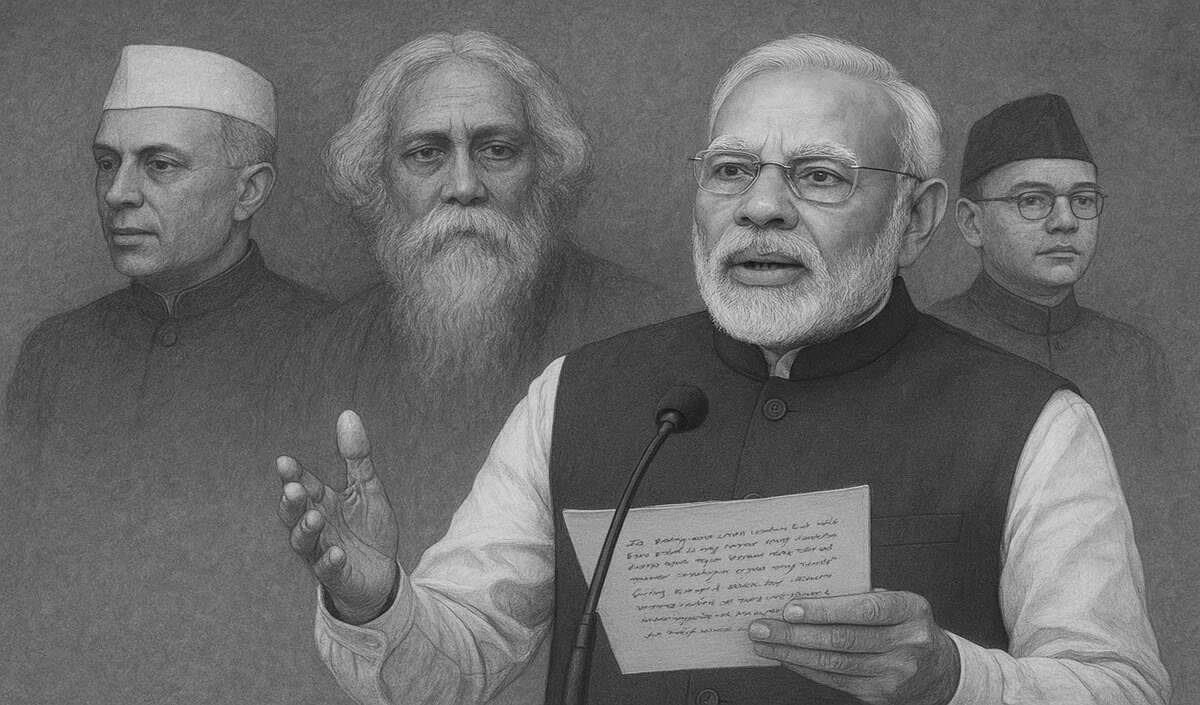
Modi pointed out that just five days after Jinnah’s opposition, then Congress President Nehru wrote to Netaji Subhas Chandra Bose, agreeing with Jinnah’s sentiments, stating that the background of Vande Mataram could irritate Muslims. This led Congress to announce a review of the use of Vande Mataram, shocking the nation.
He stated that patriots protested against this proposal, singing Vande Mataram across the country. Unfortunately, on October 26, 1937, Congress compromised on Vande Mataram, disguising it as a move for social harmony, but history shows that they capitulated to the Muslim League’s pressure.
A Vision for the Future
Modi expressed a dream for India to become a developed nation by 2047, stating that if a country could envision its freedom 50 years prior, then 25 years ago, we too could dream of a prosperous and developed India. He emphasized that there should be no division between the ruling and opposition parties in this vision.
He urged all representatives to acknowledge the debt owed to Vande Mataram, recognizing its significance in the freedom movement.
The Role of Bengal in Vande Mataram’s Legacy
The Prime Minister highlighted Bengal’s crucial role in the creation of Vande Mataram and its journey to becoming the national song. He noted that the British first targeted Bengal for division, believing that once Bengal was fractured, the entire country would follow suit.
He reiterated that when the British committed this sin in 1905, Vande Mataram remained a steadfast symbol of unity. The song resonated throughout Bengal, inspiring countless individuals. Modi concluded by stating that no other poem or song in history has inspired millions towards a singular goal like Vande Mataram has.